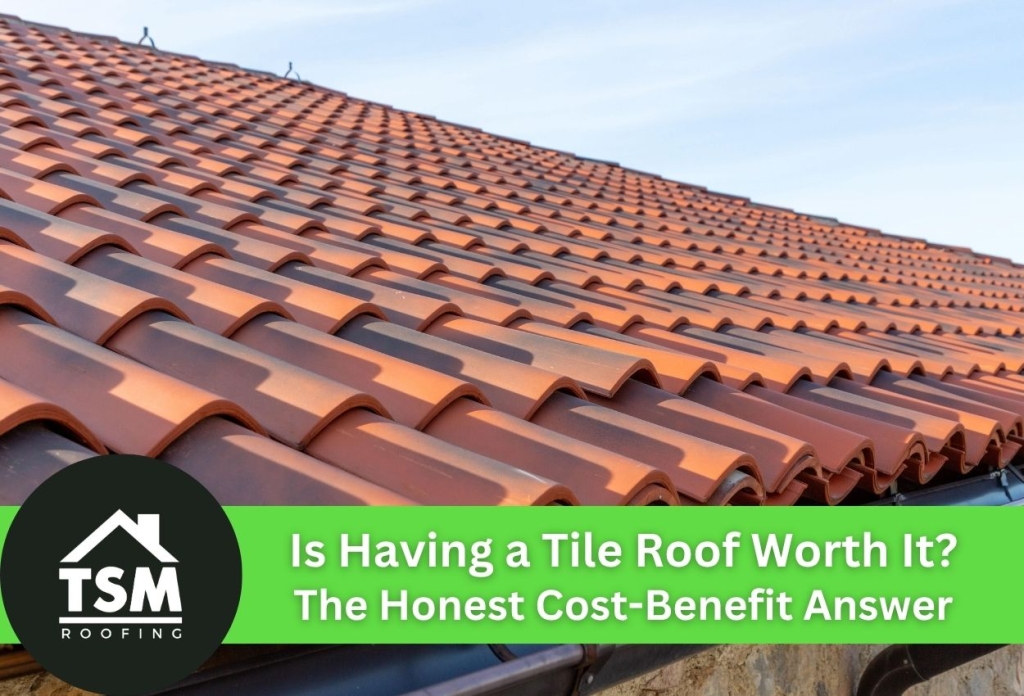

In Phoenix, installing a tile roof requires a larger initial investment than asphalt shingles. However, because tile lasts decades longer than asphalt, the long-term cost per year is much lower. That is the core tradeoff every Phoenix homeowner should understand before choosing a roofing system.
Phoenix logs 300+ sunny days annually, with summer highs reaching 105 degrees to 107 degrees Fahrenheit and monsoon storms rolling through each late summer. Those conditions are hard on lightweight roofing materials. Tile’s thermal mass slows heat transfer into the home, and its durability holds up against intense UV exposure, large temperature swings, and short, heavy rain bursts.
Understanding lifespan, required maintenance, and eventual resale value allows local homeowners to determine if a tile roof is the right long-term investment for their property.
How Does Tile Roof Cost Compare to Shingles Upfront and Over Time?
Clay tile costs roughly 2 to 3 times more than asphalt shingles upfront, but its cost per year of service life is often lower once the roof passes the 25-year mark.
| Material | Avg. Installed Cost per Square (100 sq ft) Phoenix | Total Cost 2,000 sq ft Roof | Expected Lifespan | Cost per Year of Service Life | Underlayment Replacement Interval |
|---|---|---|---|---|---|
| Clay Tile | $900 to $1,500 | $18,000 to $30,000+ | 40 to 50+ years | $360 to $750/year | Every 20 to 30 years |
| Concrete Tile | $700 to $1,200 | $14,000 to $24,000 | 30 to 50 years | $280 to $800/year | Every 20 to 25 years |
| Asphalt Shingles | $400 to $700 | $8,000 to $14,000 | 15 to 20 years | $400 to $930/year | Replaced with shingles at 15 to 20 years |
By year 25, an asphalt shingle roof will have required a complete, expensive replacement. Because of this, tile roofing becomes the more economical choice as the decades pass. Clay tile’s cost per year of service life can drop to $360 to $750, while shingles often run $400 to $930 per year when replacement cycles are factored in. Concrete tile sits in the middle, offering a lower upfront cost than clay with a lifespan that still far outlasts shingles.
How Long Does a Tile Roof Last in the Phoenix Desert Climate?
Clay tile typically lasts 50 to 100 years in Phoenix, concrete tile lasts 40 to 50 years, and asphalt shingles last just 15 to 20 years; Phoenix’s climate pushes shingles toward the shorter end of that range. Day-night temperature swings of 40 degrees or more put repeated stress on lightweight materials. That constant expanding and contracting breaks down shingle adhesives and granule bonds far faster than national averages suggest.
Where Tile Roofs Actually Fail in Phoenix
The tiles themselves rarely fail first. The most common failure point on Phoenix tile roofs is underlayment and flashing degradation. Underlayment typically lasts 20 to 30 years and must be replaced even when the tiles above it look perfectly intact. Because this replacement averages $3 to $6 per square foot, mid-life underlayment work is a large expense. The original tiles are carefully removed, the membrane is replaced, and the same tiles are reinstalled.
How Tile Handles Monsoon Season
Tile’s weight and interlocking design give it a real advantage when monsoon storms push wind-driven rain and airborne debris across the roof. Shingles can lift at the edges under strong gusts; tile holds its position. The most vulnerable spots during high-wind monsoons are ridge caps and flashing at roof edges; those areas take the most direct wind pressure and are where leaks most often start. Regular inspection of those points after monsoon season is one of the simplest ways to protect the roof’s long-term performance. TSM Roofing’s emergency roof storm damage service is available when monsoons cause unexpected damage.
What Are the Real Pros and Cons of a Tile Roof for Homeowners?
Tile roofs last 50 to 100 years, carry a Class A fire rating, and can reduce cooling by an estimated 20% to 25%, but they cost $10,000 to $18,000 more upfront than asphalt shingles on an average Phoenix home. That gap is the starting point for every tile roof pros and cons homeowners should weigh.
| Category | Pro or Con | Supporting Detail |
|---|---|---|
| Lifespan | Pro | Clay tile lasts 50 to 100 years; concrete tile lasts 40 to 50 years, far beyond shingles at 15 to 20 years |
| Energy performance | Pro | Thermal mass can reduce cooling by an estimated 20 to 25% per DOE estimates |
| Fire resistance | Pro | Class A rated the highest fire resistance rating available for roofing materials |
| Upfront cost | Con | $10,000 to $18,000 more than shingles on an average Phoenix home |
| Structural weight | Con | Clay tile runs 9 to 12 lbs per square foot; may require framing upgrades costing $1,500 to $5,000 or more |
| Repair fragility | Con | Walking on tile incorrectly causes cracking; individual tile replacement runs $150 to $400 per repair call. |
In Phoenix, the pros carry extra weight. UV resistance and thermal performance matter far more here than in cooler or wetter markets, where those advantages are much smaller. A tile roof’s ability to slow heat transfer is one of the most valuable features a Phoenix homeowner can have during summers that push 105 degrees to 107 degrees for weeks at a time.
Long-term owners, homeowners with stucco or Mediterranean-style homes, and those focused on keeping energy costs down tend to get the most value from tile. Homeowners planning to sell within 10 years or working with a tight upfront budget may find it harder to recover that $10,000 to $18,000 cost premium before the home changes hands. TSM Roofing LLC can help Phoenix homeowners run through both scenarios before committing to a material.
What Does Tile Roof Maintenance Actually Cost Over Time?
A Phoenix homeowner with a tile roof should budget roughly $8,000 to $15,000 in total maintenance costs over 30 years compared to $3,000 to $6,000 for asphalt shingles, but shingles also require a full replacement at year 15 to 20 that adds another $8,000 to $14,000, making tile’s 30-year total cost competitive.
Four recurring tasks drive most of that tile maintenance spending.
- Annual or biennial inspection: A professional residential roof inspection runs $150 to $300 per visit. Most Phoenix roofers recommend scheduling one every 1 to 2 years, with at least one post-monsoon check each fall to catch any underlayment or flashing issues before winter rains arrive.
- Underlayment replacement: At $3 to $6 per square foot, replacing the underlayment on a 2,000-square-foot roof costs $6,000 to $12,000. This work is needed every 20 to 30 years, even when the tiles above it look perfectly fine.
- Cracked or broken tile replacement: Individual tile repairs run $150 to $400 per service call. Cracking most often happens when someone walks the roof without proper technique, or after debris impact during a monsoon storm.
- Valley and gutter debris clearing: Dust, dead vegetation, and monsoon debris pack into roof valleys and gutters fast. A professional cleaning costs $150 to $250 per visit. Most Phoenix homeowners need this done twice a year, once after monsoon season ends and once in spring.
Skipping underlayment inspections after monsoon season is the most common cause of premature interior water damage on Phoenix tile roofs because the tiles look untouched while the membrane underneath quietly fails. Staying on a regular inspection schedule is the single best way to protect a tile roof’s long-term value.
Is a Tile Roof Worth the Extra Cost? Who Should and Shouldn’t Choose Tile?
Tile is worth the extra cost if a homeowner meets at least 3 of the following 6 criteria. Homeowners who stay 20+ years typically recover the cost premium through lifespan advantage, avoided replacement cycles, and energy savings; those selling in under 10 years are unlikely to recoup the gap.
- Long-term ownership: The homeowner plans to stay 15+ years. Tile’s lifespan of 40 to 100 years delivers full value only to owners who hold the home long enough to avoid at least one shingle replacement cycle.
- Structural capacity: The current roof framing can support 9 to 12 lbs per square foot without reinforcement. If upgrades are needed, that work adds $1,500 to $5,000 before the first tile is installed.
- Home style match: The home is Mediterranean, Spanish, or stucco construction, where tile adds measurable resale appeal compared to asphalt shingles on the same style of home.
- High cooling costs: Annual cooling bills exceed $2,400. Tile’s thermal mass can reduce cooling by an estimated 20 to 25%, making the energy savings meaningful over time.
- Budget readiness: The homeowner has cash or financing in place for $18,000 to $30,000 upfront, the installed cost range for clay tile on a 2,000-square-foot roof.
- HOA or neighborhood standards: The Homeowners Association or neighborhood standards favor or require tile roofing as the approved material.
When Tile Is Likely Not Worth It
- Tight budget with no financing: Homeowners who cannot cover $18,000 to $30,000 upfront without financial strain should consider concrete tile or residential asphalt shingles instead.
- Planned sale within 5 to 10 years: Recovering a $10,000 to $18,000 cost premium over asphalt in a short ownership window is unlikely in most Phoenix markets.
- Structural upgrades required: If framing reinforcement would cost $5,000 or more before tile installation can begin, the total project cost may not be justified.
Properties meeting three or more of these benchmarks are prime candidates for tile. If your situation does not match these factors, exploring high-quality asphalt alternatives may be wiser.
What ROI and Resale Value Does a Tile Roof Add to a Phoenix Home?
Roofing projects return 60% to 70% of their cost at resale nationally, but in high-tile markets like Phoenix, that figure climbs closer to 70% to 80% because buyers expect tile on stucco and Mediterranean-style homes. A newer tile roof is a strong selling point; an aging shingle roof is not.
The buyer-side math is straightforward. A home listing with a tile roof under 10 years old avoids the buyer’s anticipated $8,000 to $14,000 shingle replacement cost. That anticipated cost does not disappear; buyers simply price it into their offer as a deduction, or use it as negotiating leverage to push the sale price down. A tile roof removes that conversation entirely and can speed up the sale.
For homeowners who installed tile 20 to 30 years ago, the resale value question connects directly to the underlayment. Replacing underlayment and flashing on a structurally sound tile roof runs $8,000 to $15,000, roughly half the cost of full reroofing, and extends the system another 20 to 30 years. That math makes the decision simple for long-term owners: spend half as much, keep the tile, and preserve the resale advantage that Phoenix buyers already factor in when shopping stucco homes.
Ready to Find Out If Tile Is Right for Your Phoenix Home?
Knowing whether your framing can handle 9 to 12 lbs per square foot without a $1,500 to $5,000 reinforcement bill starts with one conversation and a structural assessment, not a guess. TSM Roofing LLC works with Phoenix homeowners to review framing capacity, run the full cost comparison, and give a clear answer before any commitment is made.
Fall and early spring are the best windows for tile roofing work in Phoenix. Plan to schedule your consultation 4 to 8 weeks ahead of your target installation date to avoid summer heat delays and monsoon disruption.
Not ready to schedule? Learn more about tile roof installation and replacement.